Herakles knots & Sabazios hands
Meaning
The reef knot, or Herakles knot, was thought to have healing power and was linked with the hero Herakles and with marriage: two lives bound firmly. Votive hands of the Phrygian god Sabazios, making a blessing gesture and covered in symbols, are a related protective form.
Intent
The knot was worn on diadems, belts and jewellery to protect, to speed the healing of wounds (Pliny says binding a wound with it speeds healing) and to bless marriages. Sabazios hands were set up in shrines and homes for protection.
Significance
The Herakles knot is the ancient origin of 'tying the knot'. Sabazios hands show the eastern mystery cults that entered Rome, with their dense layered symbolism.
History
The Herakles knot appears in Greek jewellery from the 4th century BCE and is characteristic of Hellenistic gold work (after Alexander). Sabazios hands date to the Roman imperial period, 1st–3rd century CE.
Making yours
Knots are 2–5 cm, made from twisted gold tubes, often with a garnet. Sabazios hands are 15–20 cm cast bronze making a blessing gesture.Greece, Etruria & Rome: the tradition
Greeks called amulets periapta or phylakteria, 'things tied on' and 'protectors'; Romans said amuletum or ligatura. Both cultures feared the envious glance, baskania in Greek and invidia or fascinatio in Latin, and answered it with laughter, shock and the power of images: the Gorgon's face, the phallus, the crescent moon. Children, brides, soldiers and livestock were the most protected. Graeco-Egyptian magicians of the Roman Empire engraved gems and gold foils with divine names and signs, forming a written magic that passed to Byzantium, Islam and medieval Europe. Pliny the Elder's Natural History (77 CE) records hundreds of amuletic stones, plants and animal parts, and became the source book for later lapidaries.
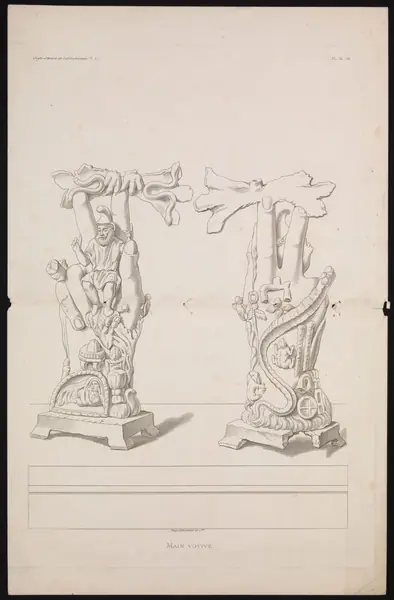 An ancient votive hand. Etching.
 Hercules knot as a symbol of fidelity with amuletic properties 2
 An ancient votive hand. Etching.
 Hercules knot as a symbol of fidelity with amuletic properties
 An ancient votive hand. Etching.
More from Greece, Etruria & Rome: Magical gems (Abraxas, Chnoubis) · Amulet capsules & gold lamellae
Every type in the gallery
Anything in the gallery can be made, by hand, in the prescribed metal or yours and, where the tradition names an hour, at that hour or with a plain note that it was not. Numbered. Price on commission, quoted first. I reply within one business day.